
ARRANGED MARRIAGES VS. LOVE MARRIAGES: ETHICAL CONSIDERATIONS AND THE ROLE OF PARENTAL GUIDANCE
"Arranged Marriages vs. Love Marriages: Ethical Considerations and the Role of Parental Guidance"
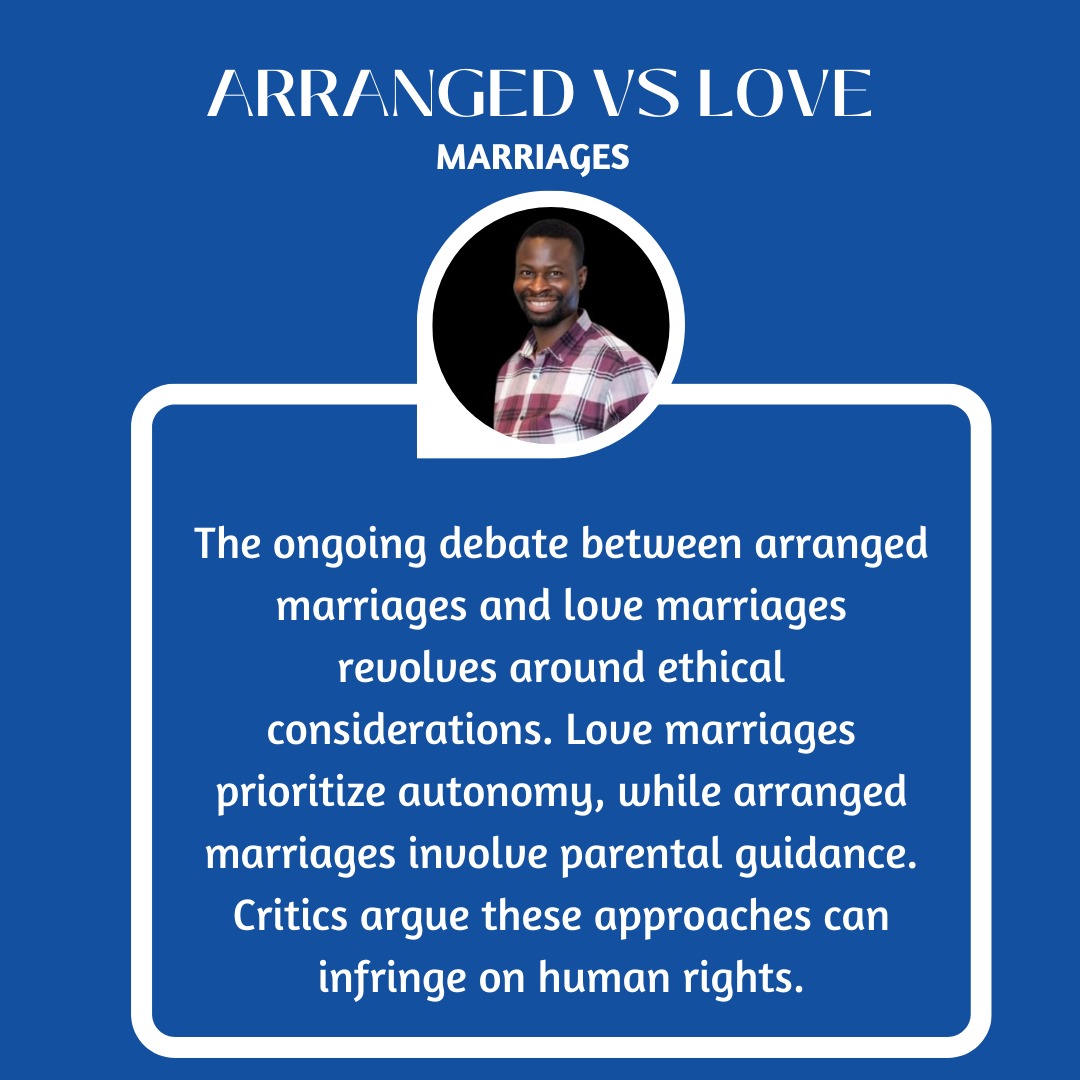
The debate between arranged marriages and love marriages has persisted for generations, each approach bearing its own set of ethical considerations. While love marriages are rooted in the idea of personal choice and autonomy, arranged marriages often involve parental guidance and family involvement. This article delves into the ethical aspects of both marriage approaches and explores how parental guidance plays a significant role in shaping the union of two individuals.
One of the primary ethical considerations in the context of marriage is the idea of personal autonomy and choice. In love marriages, individuals have the freedom to choose their life partners based on their feelings and compatibility. This emphasis on autonomy is aligned with modern Western values, placing a high premium on personal liberty.
In contrast, arranged marriages may be seen as potentially compromising individual autonomy. The ethical question here lies in whether it is justifiable for parents or guardians to make such a significant life decision on behalf of their children. Critics argue that forced or coerced arranged marriages can infringe upon the fundamental human right to choose one's life partner. However, it is important to note that not all arranged marriages are forced, and many individuals in such unions have agency in the decision-making process.
Ethical considerations often extend beyond the individual to encompass broader societal values. Arranged marriages are deeply rooted in many cultures and are often seen as a means to promote family values and social cohesion. The emphasis is placed on the compatibility of families, not just individuals. While this might appear to limit personal freedom, it is based on the belief that strong family ties contribute to a harmonious and stable society.
In love marriages, the ethical concern could be viewed as an excessive emphasis on personal happiness, potentially at the expense of familial and societal bonds. Critics argue that this focus on individual happiness might lead to societal fragmentation, as individual desires often take precedence over the greater good.
One of the distinctive features of arranged marriages is the role of parental guidance. Parents or guardians often play an active role in the matchmaking process, bringing their experience and wisdom to the table. Ethically, this can be seen as a form of protection and support for their children. Parents aim to ensure their child's happiness and well-being by selecting a suitable life partner.
In love marriages, parental guidance can be less prominent. While many parents support their children's choice, some may have concerns, which can lead to ethical dilemmas. The balance between individual choice and parental guidance can be delicate, as parents may fear their child's judgment might be clouded by emotions. Ethical questions arise about when, if at all, it is acceptable for parents to intervene in their child's choice of spouse.
A fundamental ethical aspect of any marriage is the commitment to creating a harmonious partnership. Both arranged and love marriages can be successful when built on trust, understanding, and communication. The ethical value of a marriage, regardless of its origin, lies in the commitment of the couple to create a loving and respectful union.
In conclusion,arranged marriages and love marriages each have their unique ethical considerations. Love marriages place a strong emphasis on personal autonomy and choice, reflecting the values of individualism. In contrast, arranged marriages often emphasize family values and social harmony, with parental guidance playing a central role.
Ethical questions surrounding these two approaches revolve around issues of autonomy, societal values, and the role of parents in shaping their children's marital decisions. Ultimately, the ethical quality of a marriage, whether arranged or based on love, hinges on the respect, trust, and understanding that the couple brings to their partnership. The key is to ensure that the rights and choices of individuals are respected while also appreciating the importance of family values and social cohesion.


0 COMMENTS