
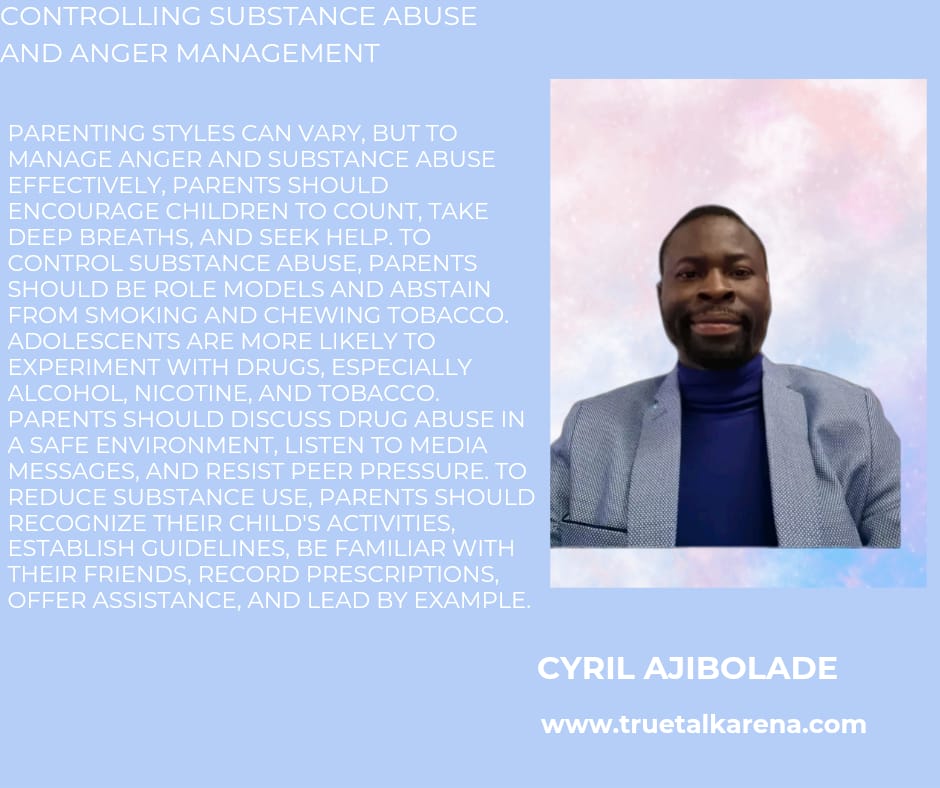
CONTROLLING SUBSTANCE ABUSE AND ANGER MANAGEMENT
*Controlling Substance Abuse and Managing Anger*
I'll start by giving us an overview of the many *Parenting Styles* that we can use or adopt in our households.
1. Authoritarian: Issue commands without considering the emotions of the kids. His words are final.
2. Dominant. desires things done his way, yet he'll listen to the kids and still convince them to follow his lead.
3. Accepted. Pay attention to the kids, and occasionally let them follow their own rules while bending his rules
4. Disengaged... disregards important choices. The world is free. gives the kids freedom to do anything they desire, right or wrong.
*MANAGEMENT OF ANGER*
How can we support a youngster who struggles with anger management?
Your youngster could be inspired to:
1. * Count from 1 to 10*
2. *Leave the surroundings*.
3. Take a deep, steady breath.
4. To release tension, they clench and unclench their fists.
5. *Report or discuss with a reliable person before responding*.
6. *Go somewhere quiet to collect yourself.*
*Increased Anger in Children*
Frustration when a child doesn't receive what they want or is asked to do something they don't feel like doing is a common trigger.
There are methods for disciplining these kids in this situation.
*How To Reprimand A Youngster Who Has Anger Problems*
1. Give them space: They should be allowed to spend some alone time. If you notice that they are becoming agitated, give them the opportunity to leave the place.
2. Consider implementing an award system: state that you will provide something to them if they perform well for a certain number of days, as an alternative to punishing misbehaviour.
The second problem is
*Control of Substance Abuse*
A pattern of substance (drug) usage that results in serious issues or suffering is referred to as substance abuse. Examples of this include:
1. Not showing up to school.
2. drug abuse in risky circumstances (driving a car),
3. Legal issues stemming from substance abuse, or persistent substance usage that ruins friendships and/or familial ties.
*Drugs That Adolescents Use That Are Harmful*
heroine
Diethylamide lysergic acid (LSD),
3,4-methylenedioxymethamphetamine (ecstasy), marijuana (cannabis),
Methaqualone
*MECHANISM OF PARENTAL CONTROL*
1. By being great role models and abstaining from smoking and chewing tobacco, parents can help prevent their adolescent from smoking and using smokeless tobacco products.
2. Being upfront about the dangers of tobacco use, urging young people who currently smoke or chew to give it up, and helping them to get help from a doctor
*Drug Abuse Risk Factors Among Teens*
Typical contributing variables to adolescent drug misuse are:
An addiction to drugs runs throughout the family.
2. A mental illness or behavioural issue, such as ADHD (attention deficit/hyperactivity disorder), depression, or anxiety.
2. Impulsive or reckless actions.
3. A past filled with terrible experiences, including seeing or participating in a vehicle accident or being abused.
4. A low sense of self-worth or social rejection.
Adolescents who are socialising may be more inclined to experiment with drugs for the first time.
Among the first, more accessible drugs for teenagers to obtain are probably alcohol, nicotine, and tobacco.
Even though alcohol, nicotine, and tobacco are not safe for minors, they may appear safer to attempt since they are legal for adults.
*Repercussions of Drug Abuse*
Addiction to drugs by teenagers can have harmful effects such as:
1. *Substance abuse.* Substance use disorders are more likely to develop in some teenagers who abuse drugs.
2. *Impaired discernment*. Adolescent drug use is linked to poor decision-making in interpersonal and social situations.
Third, *Intercourse*. Drug usage is linked to risky sexual behaviour, unintended pregnancies, and high-risk sexual activity.
*Diseases of the mind.*
Substance abuse can exacerbate mental health conditions like anxiety and depression or raise the chance of developing them.
4. Driving when intoxicated. Any drug's influence on driving impairs one's ability to drive. It endangers everyone on the road, including the driver and passengers.
*A shift in academic achievement*. Poorer attendance, academics, and overall school experience can be caused by substance abuse.
*Talking About Substance Abuse With The Child*
You and your youngster will probably talk about drugs and alcohol a lot.
If you are having a chat with your teen about substance use, pick a location where you both feel at ease and a time when you won't be disturbed. That implies that you will both need to put your phones away.
Knowing when *NOT* to engage in conversation is also crucial.
It's preferable to put off the conversation when kids or parents are upset. Parents may inform teenagers that you will discuss the subject at a later time if you are ill-prepared to respond to their inquiries.
*SPEAKING WITH THE CHILD ABOUT THE USE OF SUBSTANCE*
Keep in mind that you should wait till the child is quiet and sober if he is drunk.
To discuss drugs with your adolescent:
1. *Get your teen's opinion.* Steer clear of lectures. Rather, pay attention to your adolescent's thoughts and inquiries around drugs. Teens can be reassured by parents that they can be open and honest and have a conversation without facing consequences.
2. *Talk about the reasons not to take drugs*.
Steer clear of fear tactics. Stress the impact that drug usage can have on your teen's crucial relationships. Sports performance, driving, health, and appearance are a few examples.
3. *Take note of media messaging*.
Drug use can be portrayed as normal or glamorous in songs, movies, television shows, and social media content. Discuss with your teen what they hear and see.
4. *Talk about how to fend off peer pressure.* Discuss with your adolescent how to decline drug offers.
5. *Get ready to talk about your personal drug use*. Consider your response in the event that your teenager inquires about your own drug or alcohol use. Tell us why you decided not to use drugs if you did. If you have used drugs, tell us what you learned from the experience.
Lastly, apply the subsequent techniques to
*_Reduce Adolescent Substance Use_*
Recognise your adolescent's activities.
Keep an eye on your adolescent's location. Find out what your adolescent enjoys doing with an adult supervisor, then urge them to participate.
2. *Determine guidelines and penalties*. Describe the rules your family has set, such as not getting into a car with a drug-using driver and leaving a party where drugs are used. If the driver is under the influence of drugs, work with your adolescent to come up with a safe return home strategy. Enforce sanctions consistently when your teen disobeys the rules.
3. Be familiar with your teen's pals.
Your adolescent may feel pressured to try drugs if their friends do.
4. *Record prescription medication*. Make a list of every prescription and over-the-counter drug you have in your house.
5. *Offer assistance*. When your teen achieves, give them encouragement and appreciation. A close relationship between you and your adolescent may help keep them away from drugs.
6. **Lead by example.** Consume alcohol in moderation if you do. Take pharmaceutical medications as prescribed. Avoid using illegal drugs.


0 COMMENTS