
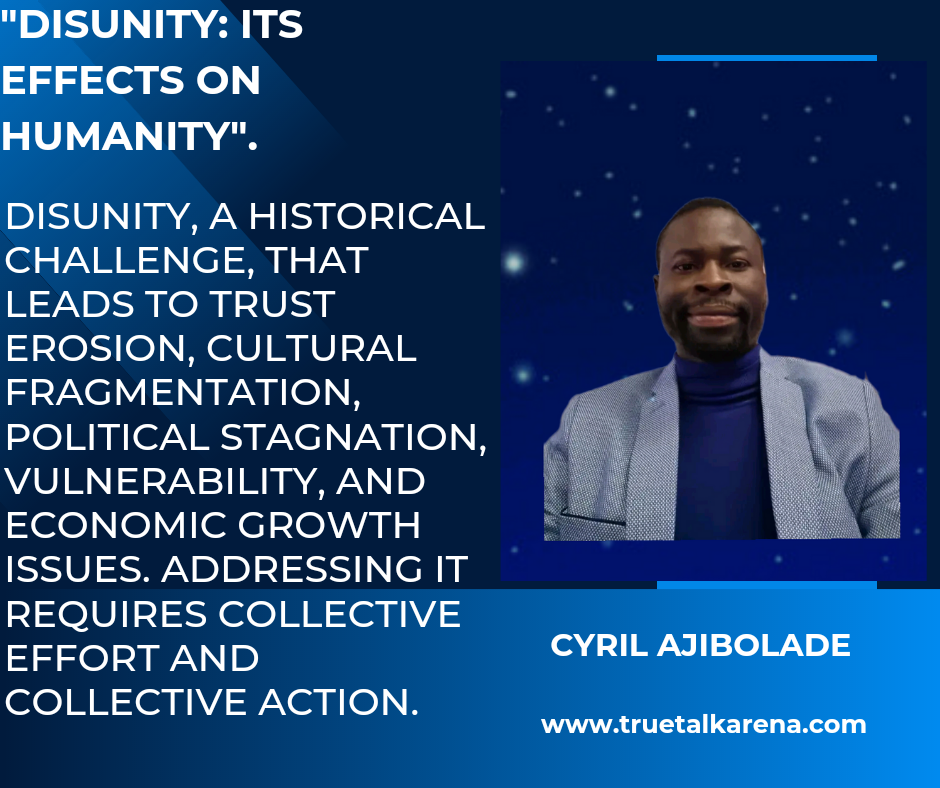
DISUNITY: ITS EFFECTS ON HUMANITY
Disunity, the lack of harmony and cohesion among individuals or groups, has been a persistent challenge throughout human history, leaving a profound impact on societies and civilizations.
This article delves into the multifaceted effects of disunity on humanity, exploring its ramifications across social, political, and economic realms.
SOCIAL RAMIFICATIONS:
Erosion of Trust:Disunity erodes the foundation of trust that binds individuals together. In a society marked by suspicion and division, people become reluctant to cooperate, hindering the formation of strong social bonds.
Cultural Fragmentation:Diverse cultures contribute to the rich tapestry of human civilization, but disunity can lead to the fragmentation of cultural identities. This often results in misunderstandings, intolerance, and even conflict between different ethnic, religious, or cultural groups.
Weakened Social Fabric:A cohesive society relies on a robust social fabric woven with shared values and a sense of collective identity. Disunity tears at this fabric, leaving individuals isolated and communities fractured.
POLITICAL IMPLICATIONS:
STAGNATION AND INEFFICIENCY:Political disunity hampers progress and efficiency as conflicting interests impede the formulation and implementation of coherent policies. This stagnation can hinder societal development and exacerbate existing challenges.
VULNERABILITY TO EXTERNAL THREATS:Nations plagued by internal divisions are more susceptible to external threats. Disunity weakens a country's ability to present a united front in times of crisis, making it easier for external forces to exploit internal discord.
POLARIZATION AND EXTREMISM:Disunity often leads to political polarization, where extreme ideologies gain traction. This polarization can manifest in the form of radical movements, further deepening societal divisions and potentially leading to violence.
ECONOMY CONSEQUENCES:
IMPAIRED ECONOMIC GROWTH:A lack of unity can hinder economic progress. Infighting among political factions, labor disputes, or social unrest can disrupt economic activities, leading to reduced investment, productivity, and overall growth.
INCOME INEQUALITY:Disunity may contribute to economic disparities as different groups vie for resources and opportunities. This can exacerbate existing inequalities, creating a society where wealth and opportunities are unevenly distributed.
GLOBAL COMPETITIVENESS:Nations that fail to address internal disunity may struggle to compete on the global stage. A fragmented society may find it challenging to coordinate effectively, limiting its ability to respond to global challenges and opportunities.
PSYCHOLOGICAL IMPACTS:
STRESS AND MENTAL HEALTH ISSUES:Living in a disunited society can take a toll on individuals' mental health. Constant exposure to social and political discord can contribute to stress, anxiety, and a sense of hopelessness.
LOSS OF COMMUNITY SUPPORT:In a disunited environment, the traditional support systems provided by communities may erode. This can leave individuals feeling isolated and without the social networks that are crucial for emotional well-being.
EROSION OF EMPATHY:Disunity can foster an environment where individuals become less empathetic towards those outside their immediate circles. This lack of empathy can contribute to a breakdown in social cohesion and mutual understanding.
IN SUMMARY, disunity poses a significant threat to humanity, impacting various facets of our existence. From social fragmentation to political instability and economic challenges, the effects of disunity are far-reaching. Addressing this issue requires collective effort, emphasizing the importance of fostering understanding, tolerance, and cooperation on a global scale. Only through concerted actions can humanity hope to overcome the divisive forces that threaten our collective well-being.


0 COMMENTS