
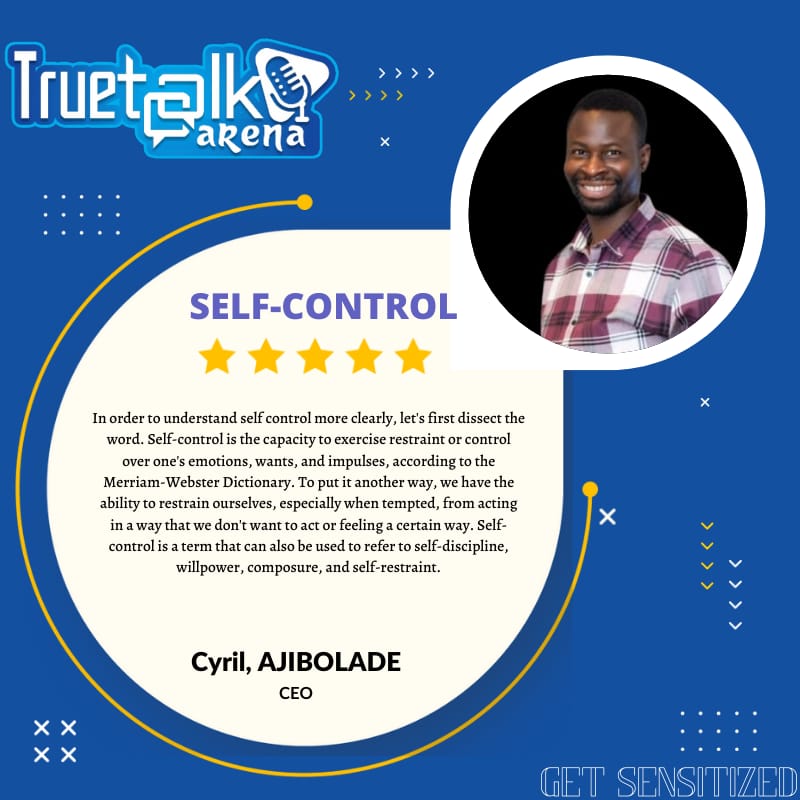
Self Control
In conversations about health and wellbeing, the word "self-control" is frequently used. We frequently consider it when trying to quit a behaviour we detest, like consuming junk food, or when trying to control an emotion, like anger. But the real definition extends beyond these concepts. The definition of self-control in its truest sense is given here, along with tips on how to develop it.
Self-Control Defined
In order to understand self control more clearly, let's first dissect the word. Self-control is the capacity to exercise restraint or control over one's emotions, wants, and impulses, according to the MerriamWebster Dictionary. To put it another way, we have the ability to restrain ourselves, especially when tempted, from acting in a way that we don't want to act or feeling a certain way. Self-control is a term that can also be used to refer to self-discipline, willpower, composure, and self-restraint.
Control is the ability to exert control over one's thoughts and behaviours in order to minimize unfavourable effects and enhance beneficial ones. The adjective self controlling, which is defined as "restraint of oneself or one's thoughts, feelings, responses, etc.," is another term from self control.
The capacity to exert control over one's thoughts and behaviours in order to reduce negative impacts and increase positive ones is known as control. Another phrase from self control is the adjective self controlling, which is described as "restraint of oneself or one's thoughts, feelings, responses, etc."
Additionally crucial is emotional restraint. It stops us from striking someone when they wrong us or yelling at them when we're furious. Additionally, it prevents us from sobbing uncontrollably when we don't get our way or from getting side-tracked in critical situations.
Although we learn to self-soothe as infants (by sucking on a pacifier, for example), we do not naturally possess self-control. We continue to hone this ability far into adulthood, if not our entire lives. This is why it's common to witness a frustrated toddler fling a toy across the room, yet an adult acting in the same way would seem strange.
However, sometimes people have either too little or too much self-control when they reach maturity. Both circumstances are not ideal. Too little or too much self-control can have negative social and psychological impacts including loneliness, melancholy, or anxiety in addition to the potential physical and emotional difficulties this may bring. If you want to grasp what a healthy level of self-control looks like, you should first be aware of what too much or too little self-control looks like. There we'll start.
Signs Of Too Much Self-Control
People typically appreciate someone who can maintain control over their emotions, desires, and behaviours. But if someone has too much self-control, they might have trouble. People with extreme self-control occasionally come off as perfectionists or as being domineering. This conduct is described as "over control" by experts. One who struggles with "over control" could go through the following:
Difficult to unwind separation from. others
rigid character
Excessive attention to detail
Absence of emotion or emotional expression
Being accountable (to a fault)
Avoiding danger
Generally speaking, persons who have excess self-control don't stand out as much as those who don't.
Why? Because of the way they behave, which is frequently characterized by favourable adjectives or traits like as sensible, introverted, or hardworking. In light of this, how can we tell if someone is simply mature or if they have excessive self-control? Well, that depends on the person.
It's likely that everything is alright if someone's activity benefits them and causes little to no distress. However, they might benefit from consulting a qualified counsellor if their excessive self-control makes their physical, mental, emotional, or social lives difficult.
Signs Of Too Little Self-Control
It's simple to recognize someone who lacks self-control. They frequently struggle to form good habits, and they might not have the same emotional or behavioural self-control as their peers. Low self-control may show itself in:
Little to no self-control ambitions that are absent or unattainable
Inadequate drive
Almost no willpower
Inability to regulate one's emotions
Absence of commitment
Quick to place blame
Sustaining friendships is difficult
Dangerous or too passive way of living.
Self-control issues (or lack thereof) have a significant impact on a person's day-to-day life. Building selfconfidence is challenging, but so is collaborating with people and accomplishing goals. Someone may need to practice self-control if they keep running into the same roadblocks. Likewise, if they lack focus or come out as immature, a lack of self-control may be to blame.
How To Have Self-Control.
Self-control varies from person to person and scenario to situation, but the majority of us could use a boost to strike a better balance between too little and too much. Here are some pointers to get you going.
Relax
When we fool ourselves into believing something needs to be done urgently or stopped right away, it can be difficult to maintain self-control. When we are motivated by our gut reactions, we also battle with self-control. Imagine you are traveling at a high rate of speed when a sluggish vehicle suddenly cuts you off. What makes you want to beep your horn, scream at them, or do worse is your gut reaction.
Learn to pause your thoughts so you can control your gut impulses in order to offer yourself the best opportunity at a calmer response and a better day. Relaxation may be beneficial. Practices for relaxing include deep breathing, mindfulness, and meditation. The more at ease you are, the more probable it is that you will approach stressful situations with composure and opt for deliberate actions over impulsive ones.
Prepare Yourself
Self-control is challenging to exercise without guidance. Planning ahead can be useful, for instance, if you need to forego your daily dessert in order to lose 10 pounds. Consider techniques to control your appetite beforehand to increase your chances of success rather than relying on your strength to carry you through when the moment arrives.
Make a strategy for what you'll do the next time you're put to the test so that you won't have to rely on willpower. When you have a sugar urge, you might want to schedule 15 minutes of yoga or a nice book. You can eventually increase your self-control by using diversions like these. Over time, you'll discover that you can control your negative emotions and that you don't have to give in to every want.
Decide what you want.
Sometimes our inability to regulate ourselves results from our lack of clarity on our goals. Make sure it's not the case if, for instance, you feel that your current employment is taking you nowhere because you are unsure of your next steps. When you are focused on making decisions that will move you in the correct path, it is simpler to practice self-control. A qualified therapist may assist you in pinpointing your personal motivators and can be an effective tool in assisting you in achieving your objectives while exercising self-control.
Having said that, it's crucial to set relevant goals for yourself. Set goals only if you are motivated to do so by yourself or other factors. Find out why your objective is important to you by looking inside of yourself. It will be incredibly challenging to commit yourself to something if it holds no meaning for you.
Keep The Consequences in Mind
Often, a straightforward assessment of the repercussions suffices to inspire someone who has trouble exercising self-control. Imagine having an additional $100. The desire to spend money on supper and a movie is stronger than the knowledge that you should use it to pay down your credit card. Think about the outcomes to help you choose the best course of action.
Will you be taking measures to get out of debt and toward financial freedom if you pay off your credit card? Will you still have enough money to pay the credit card account on time if you reward yourself, or will you incur another late fee or worse?
Consider the long-term benefit rather than just the immediate satisfaction. Your ability to regulate yourself will inevitably improve with time as you start to reap the rewards if you take care of yourself today to put yourself up for success tomorrow.
Play a part with a friend, a member of your family, or a therapist if exercising self-control is difficult for you. With no fear of negative repercussions, this will enable you to face your emotions in a safe setting.
Consider an easy circumstance where you frequently struggle with restraint to get started. Experiment with harder or more demanding situations as your self-control develops.
Gaining Health
Being in the ideal physical, mental, and emotional states is crucial for proactive conduct as with any other. If it has been some time since your previous physical, make an appointment with your primary care physician. Your problems with self-control may be exacerbated by an underlying ailment. Therefore, if you are displaying signs of sadness, anxiety, or other mental health problems, please seek quick medical attention.
Additionally, keep in mind to take care of the fundamentals. Eat a balanced diet, get at least eight hours of sleep each night, and drink lots of water. This will support you in maintaining mental clarity while you pursue improved self-control.
True Talk Arena Can Help.
In our lives, self-control plays a significant part and frequently contributes significantly to our overall levels of happiness. While it is possible to overdo self-control, it is more common for us to have problems when we lack it. We must achieve balance if we want to develop self-control, and a counsellor can assist.
Conclusively.
The impact of self-control on your life can be profound. In fact, it's most likely to blame for the life you currently lead. A happy, successful life is attainable with the appropriate tools. Go ahead and start.
Read More on our Morality Topics:
Watch our videos and read from our blog section
Visit:
www.truetalkarena.com
WhatsApp: +447459340603
Facebook page: True Talk Arena


0 COMMENTS